
Every founder dreams about hearing this sentence:
“We would like to invest in your startup.”
But what most founders do not realize is this.
Investors are not simply funding ideas. They are funding clarity, execution capability, market understanding, and founder discipline.
And this is exactly why thousands of startups struggle to raise money even when they believe their idea is brilliant.
The Indian startup ecosystem is growing aggressively. New founders are emerging every day. Investors are actively looking for scalable businesses. Government schemes are expanding. Incubators and accelerators are growing rapidly.
But despite all these opportunities, fundraising still feels confusing for most early-stage founders.

If you are wondering how to raise funding for your startup in India, this guide will walk you through the complete process, including funding stages, investor expectations, startup preparation, common mistakes, and practical fundraising strategies.
Understanding Startup Funding in India
Before approaching investors, founders need to understand one important truth.
Funding is not the starting point of a startup.
It is a growth accelerator.
Investors typically invest when they see:
- a real market problem
- clear business potential
- capable founders
- early traction or validation
- scalability
- execution discipline
Many founders waste months chasing investors before validating their business properly.
That approach usually ends in rejection.
Types of Startup Funding in India
There are multiple funding options available depending on your startup stage.
1. Bootstrapping
This means funding the startup using personal savings or founder resources.
Most successful startups begin here.
Bootstrapping helps founders maintain ownership and build early proof before external fundraising.
2. Friends and Family Funding
This is usually the first external capital many startups receive.
However, founders should still document investments properly using legal agreements.
3. Angel Investors
Startup investors in India at the angel stage generally invest in early-stage startups with strong founder potential and market opportunity.
Angel funding usually ranges from a few lakhs to several crores depending on traction and industry.
4. Seed Funding
Seed funding for startups helps businesses scale product development, hiring, operations, and customer acquisition.
At this stage, investors expect stronger validation and measurable traction.
5. Venture Capital Funding
Venture capital firms invest in startups with high growth potential and scalability.
VC funding usually focuses on businesses that can grow rapidly across large markets.
6. Government Grants and Startup Schemes
India now offers multiple startup support initiatives including:
- Startup India
- SIDBI schemes
- MSME support programs
- state startup policies
- innovation grants
These schemes can significantly support early-stage founders.
You can also explore startup ecosystem support opportunities through the ArthSetu opportunities page.
The Different Startup Funding Stages
Understanding funding stages helps founders approach the right investors at the right time.
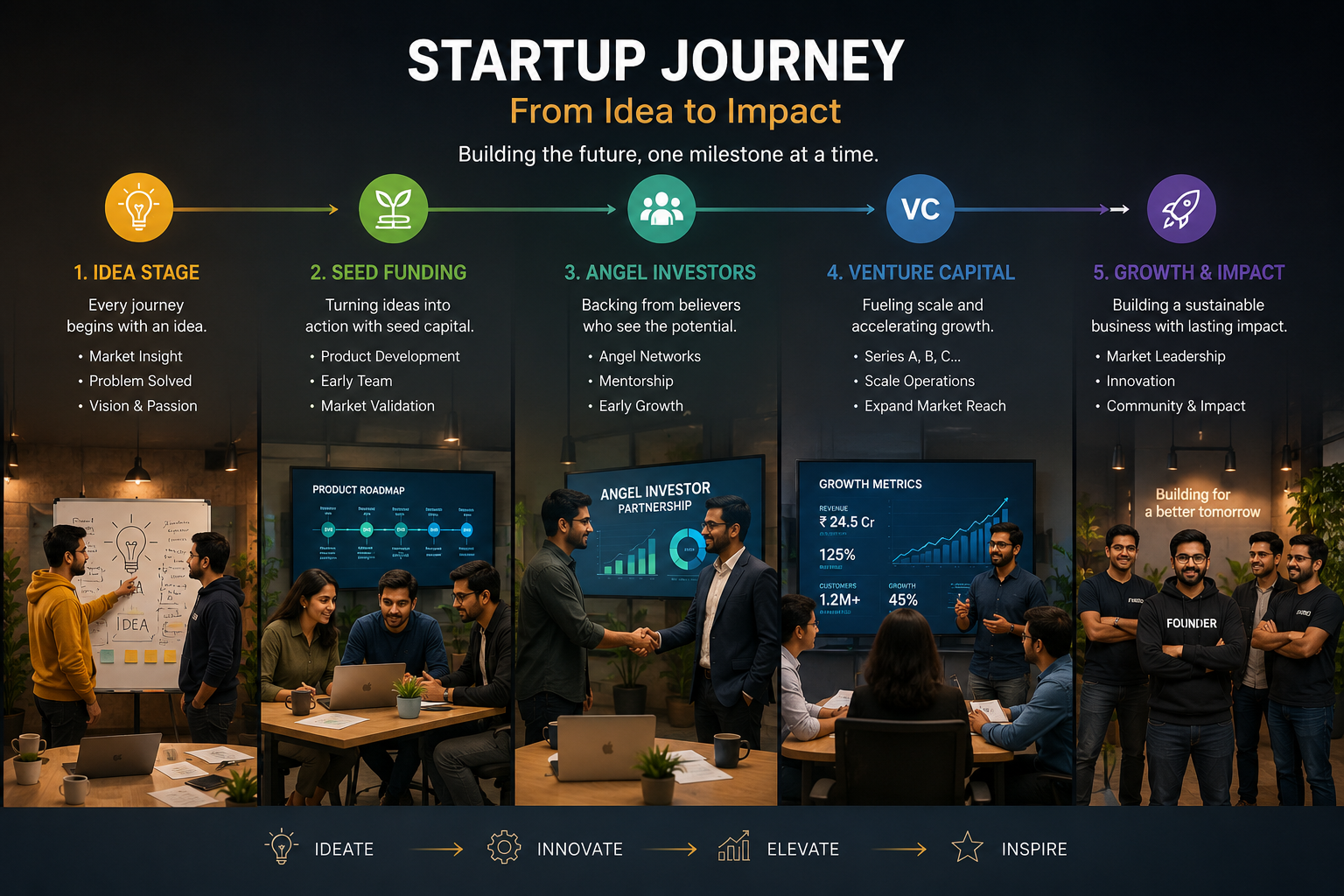
- Pre-Seed Stage: Idea validation and prototype development
- Seed Stage: Early traction and business expansion
- Series A: Scaling operations and growth
- Series B and Beyond: Market expansion and aggressive scaling
One of the biggest fundraising mistakes founders make is approaching large investors too early without sufficient traction.
What Investors Actually Look For
Most founders think investors mainly evaluate ideas.
Wrong.
Investors evaluate risk.
They ask themselves:
- Can this startup survive?
- Can these founders execute?
- Is the market large enough?
- Is the business scalable?
- Will this generate returns?
Key areas investors analyze include:
Founder Capability
Strong founders attract investors faster than average ideas with weak execution teams.
Market Opportunity
If the market size is too small, investor interest usually drops immediately.
Traction
Traction creates credibility.
This could include:
- revenue
- user growth
- partnerships
- waitlists
- pilot customers
Business Model
Investors want clarity on how the startup will eventually make money.
Scalability
Can the startup grow efficiently without costs increasing uncontrollably?
Documents You Must Prepare Before Raising Funding
Many founders approach investors emotionally instead of professionally.
That immediately reduces credibility.
Before fundraising, startups should prepare:
- pitch deck
- financial model
- founder agreement
- cap table
- incorporation documents
- market analysis
- business plan
- traction metrics
If you are still missing these documents, read our detailed guide on essential startup legal documents every founder must have.

How to Create a Strong Startup Pitch Deck
Your pitch deck is not just a presentation.
It is your startup story in investor language.
A strong pitch deck should clearly explain:
- problem statement
- solution
- market opportunity
- business model
- traction
- competition
- financial projections
- team
- fund utilization plan
Confusing decks kill investor attention quickly.
Clarity wins.
Common Startup Fundraising Mistakes
This is where most founders damage their funding chances.
1. Raising Too Early
Founders often chase investors before validating demand.
2. Weak Financial Understanding
If founders cannot explain numbers confidently, investor trust collapses.
3. Unrealistic Valuation Expectations
Overvalued startups scare investors away.
4. Poor Documentation
Missing agreements, unclear equity structure, or messy cap tables create major red flags.
5. No Clear Market Understanding
Investors expect founders to deeply understand customer pain points and market behavior.
How Startup Incubators and Ecosystems Help Founders
Early-stage fundraising becomes significantly easier when founders operate within strong startup ecosystems.
Startup incubators and founder communities provide:
- mentorship
- networking
- investor access
- funding readiness support
- business guidance
- pitch preparation
At ArthSetu, we actively support founders through ecosystem access, startup mentorship, funding preparedness, and growth guidance.
Explore more about the ArthSetu mission and how we support emerging founders.
How Long Does It Take to Raise Startup Funding?
Founders constantly underestimate fundraising timelines.
Raising startup funding in India can take:
- 3 to 6 months for early-stage rounds
- 6 to 12 months for larger rounds
This is why founders should never wait until cash is nearly exhausted before beginning fundraising discussions.
The Truth About Startup Funding
Here is the reality most startup content online avoids saying.
Funding alone does not save weak businesses.
In fact, many startups collapse after raising money because the business fundamentals were never strong enough.
Good investors are not looking for hype.
They are looking for disciplined founders solving real problems.
If your startup lacks clarity, structure, validation, or execution capability, funding conversations become extremely difficult.

Final Thoughts
Learning how to raise startup funding in India is not about memorizing investor jargon or sending cold pitch decks everywhere.
It is about building a business investors can trust.
The startups that successfully raise capital are usually the ones that prepare early, understand their numbers, validate their market, and build strong operational discipline.
If you are serious about making your startup investment ready, start by strengthening your foundation before chasing investors.
Need help with startup funding readiness, mentorship, or ecosystem support?
Connect with the ArthSetu team or join the ArthSetu ecosystem today.
Super Admin
Author & Contributor at ArthSetu
Passionate about startup ecosystem, entrepreneurship, and helping founders navigate their journey.
Share this article
Help others discover this content