
You just incorporated your startup. Now what?
Before you hire your first employee, before you pitch your first investor, before you do almost anything else, get your DPIIT Startup Recognition. It is free, it takes less than 72 hours, and it opens up a bunch of government benefits that can save you lakhs in taxes and cut through a lot of compliance headaches.
Most founders either don't know about it or keep pushing it to the "I'll do it later" list. Don't be that founder. This guide walks you through the whole process in plain language, including the big policy changes from February 2026 that most guides haven't caught up to yet.
What Exactly Is DPIIT Startup Recognition?
DPIIT is the Department for Promotion of Industry and Internal Trade, sitting under the Ministry of Commerce and Industry. When you get "DPIIT recognised," the government is officially certifying your startup under the Startup India initiative.
The best way to think about it: it is like getting a master access card. One certificate, and suddenly you can walk through doors that were previously closed or required months of paperwork to open. Tax benefits, IP protection at discounted rates, easier compliance, investor visibility, government contracts and more. We will break all of this down below.
What Changed in 2026 (Read This First)
On February 4, 2026, DPIIT released Gazette Notification G.S.R. 108(E). It updated the startup eligibility framework in ways that matter a lot. If you are reading another guide written before this date, some of that information is no longer accurate. :contentReference[oaicite:0]{index=0}
Here is what actually changed:
1. Turnover Limit Goes Up to Rs. 200 Crore
Earlier, your annual turnover had to stay below Rs. 100 crore to keep your recognised status. That ceiling has now been doubled to Rs. 200 crore. If your startup is growing fast, this gives you a much longer window to stay in the programme and keep accessing its benefits. :contentReference[oaicite:1]{index=1}
2. Deep Tech Startups Now Get 20 Years
This is a big one. DPIIT has for the first time officially defined a Deep Tech startup category. If your startup is in AI infrastructure, advanced materials, biotech, semiconductors, space tech or similar science-heavy fields, you now get recognition valid for up to 20 years from incorporation. The earlier limit was 10 years for everyone. This change acknowledges that deep tech startups often take a decade or more just to reach commercial stage. :contentReference[oaicite:2]{index=2}
3. Cooperative Societies Can Now Apply
Another first. Cooperative Societies are now eligible for DPIIT recognition. This is specifically to support innovation coming from rural and agricultural sectors. :contentReference[oaicite:3]{index=3}
4. Angel Tax Is Completely Gone
Section 56(2)(viib) of the Income Tax Act, which used to tax startups when they raised money at a valuation above fair market value, was scrapped effective April 1, 2025. It does not matter whether you are raising from domestic or foreign investors. Angel tax simply does not exist for FY 2025-26 onwards. You do not need DPIIT recognition to protect yourself from it anymore because there is nothing to protect yourself from.
5. The 80-IAC Tax Holiday Window Is Extended
The income tax holiday under Section 80-IAC now covers all startups incorporated before March 31, 2030. So even if you are registering your company today, you have a generous window ahead to use this benefit once you turn profitable.

Are You Eligible?
Before you spend time on the application, quickly check against these criteria:
| Eligibility Criterion | What You Need |
|---|---|
| Entity Type | Private Limited Company, LLP, Partnership Firm, or Cooperative Society |
| Age of Company | Less than 10 years old from date of incorporation (up to 20 years for Deep Tech) |
| Annual Turnover | Should not exceed Rs. 200 crore in any financial year since incorporation |
| Nature of Work | Innovation-focused, or a scalable business model with strong potential for job or wealth creation |
| Origin | Not formed by splitting up or restructuring an existing business |
One thing to flag upfront: sole proprietorships are not eligible. If you are running your business as a sole proprietor, you need to first incorporate as a Pvt Ltd, LLP, or Partnership Firm before you can apply.
What Do You Actually Get?
Let us get into the real stuff. Here are the benefits, split by what kicks in automatically and what needs a follow-up application.
What You Get Right After Recognition
Self-Certification for Labour and Environmental Laws
You can self-certify compliance with 6 labour laws and 3 environmental laws through the Shram Suvidha Portal. No inspectors showing up. No lengthy compliance audits. This is a genuine relief for early-stage teams that do not have a full-time HR or legal person yet.
80% Rebate on Patent Filing Fees
Filing a patent in India can cost you a fair amount. With DPIIT recognition, you get 80% off the government fees. You also get free help from government-empanelled patent facilitators.
80% Rebate on Trademark Filing Fees
Same deal for trademarks. You can protect your brand name, logo, and product names at a fraction of the usual cost.
Access to GeM (Government e-Marketplace)
GeM is where government departments and PSUs buy products and services. As a DPIIT-recognised startup, you can list on GeM without the usual turnover or experience requirements that normally gate out small businesses. Government is a real paying customer for many startup categories.
Startup India Investor Connect
Your startup gets listed on the government's investor discovery platform, giving you visibility to investors who are specifically looking for DPIIT-recognised companies.
Credit Guarantee Scheme
Access to collateral-free loans through SIDBI, which can be helpful when you are early stage and do not have assets to pledge.
Fast-Track IP Processing
Faster examination of your patent, design, and trademark applications compared to the standard queue.
What Needs a Separate Application
Section 80-IAC Tax Holiday
This is the big one financially. You get 100% income tax exemption for 3 consecutive profitable years within your first 10 years of incorporation (or 20 for Deep Tech startups). But DPIIT recognition does not automatically give you this. You need to file a separate application to the Inter-Ministerial Board (IMB) after getting your certificate. That review typically takes 45 to 90 days, so plan ahead.
Startup India Seed Fund
Grants of up to Rs. 20 lakh for proof-of-concept and up to Rs. 50 lakh for prototype development and market trials. Separate application through the SISFS portal.
Documents to Keep Ready
Pull these together before you start filling the form. Having everything ready upfront means you can submit in one shot without going back and forth.
| Document | Format |
|---|---|
| Certificate of Incorporation / LLP Deed / Partnership Registration | |
| PAN Card of the company or LLP | PDF or JPEG |
| Latest audited balance sheet or provisional financial statement | |
| Pitch deck or business plan (strongly recommended) | |
| Website URL or product demo link (if you have one) | URL |
| Brief write-up or proof showing the innovative nature of your business | PDF or JPEG |
| GST Certificate (only if applicable) |
How to Apply: Step by Step
Applications now go through the National Single Window System (NSWS) at nsws.gov.in. The old Startup India portal no longer handles new recognition applications, so make sure you are on the right platform. :contentReference[oaicite:4]{index=4}
Step 1: Create Your Account on NSWS
Head to nsws.gov.in and register using your company PAN, email, and mobile number. If you already have an account, just log in.
Quick heads up: DPIIT does not charge any fee for this. The Ministry of Commerce and Industry has not authorised any agency, consultant, or third party to collect fees on their behalf. If someone is asking you to pay for DPIIT recognition, that is a scam. The whole process is free and you do it yourself.
Step 2: Add the Startup Registration Form to Your Dashboard
After logging in, go to your dashboard and click "Add Approvals", then "Central Approvals". Look for "Registration as a Startup" and add it to your dashboard. That is where your application lives.
Step 3: Fill the Form Carefully
This step takes the most time and attention. The form asks you for your entity details like name, date of incorporation, CIN or LLPIN, PAN, and registered address. It also covers your business description, your scalability story, how you plan to create employment, and your turnover figures for each financial year.
The most common reason applications get rejected is a weak or vague innovation description. Writing "We are an IT company providing digital solutions" will likely get you rejected. You need to be specific. What technology are you building? What gap in the market are you solving? What makes your approach different from what already exists?
Treat this section like a short pitch. Write it as if you are explaining your startup to someone who reviews hundreds of applications a week and can spot a generic description from a mile away.
Step 4: Upload Your Documents
Upload everything in the correct format (PDF or JPEG as specified). Double-check that your Certificate of Incorporation is clearly legible and that your financial statement shows your turnover is within the eligible limit.
Step 5: Submit and Wait
Once submitted, DPIIT reviews your application. Most complete applications are processed within 1 to 3 working days, and many get approved within 24 hours. If something is missing or unclear, they will come back with a request for more information, which adds a few more days to the timeline. Getting it right the first time genuinely saves you a week.
Step 6: Download Your Certificate
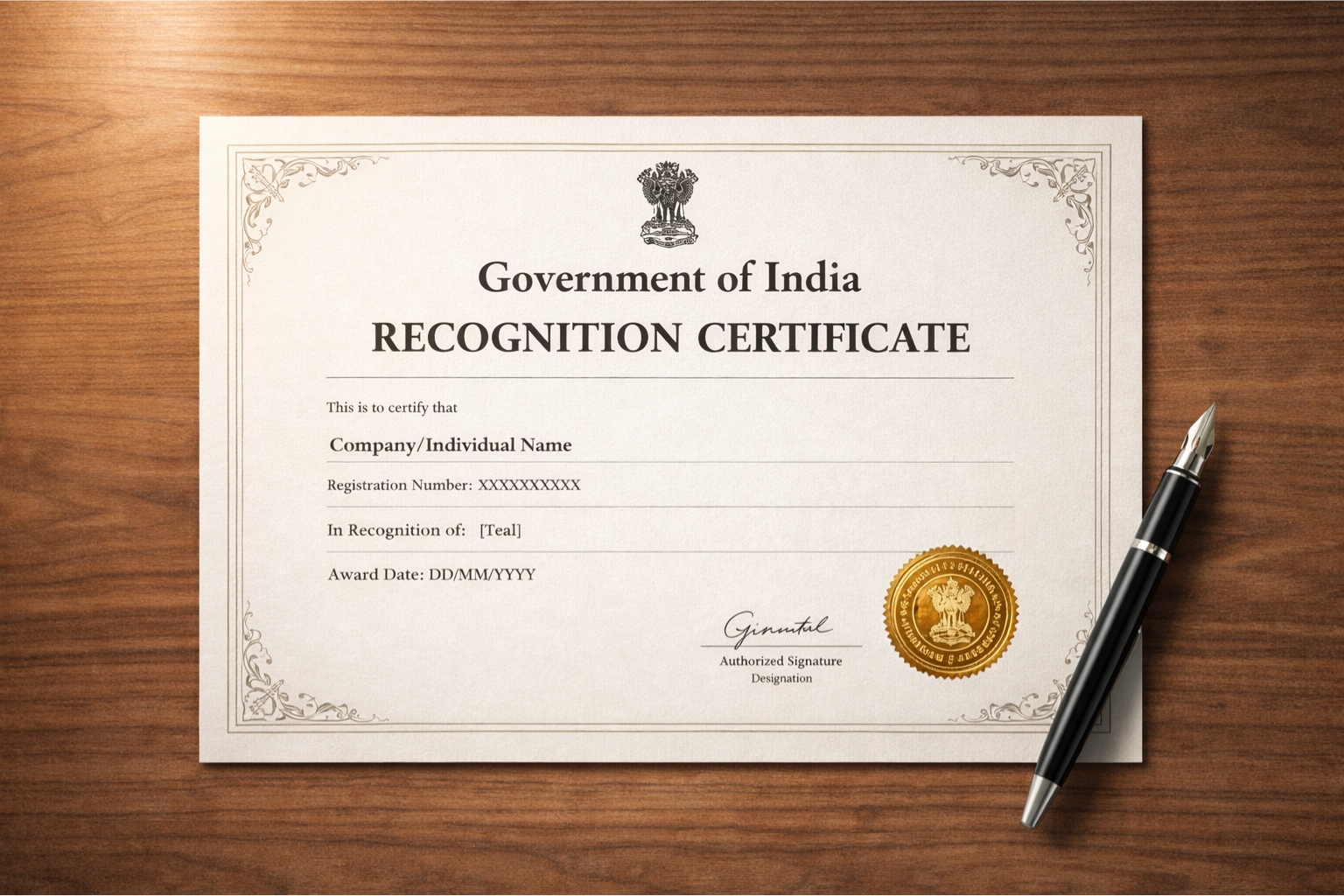
Once approved, your DPIIT Certificate of Recognition lands in your email and shows up on the portal. Download it and store it somewhere easy to find. You will need to attach it every time you apply for a follow-on benefit.
What to Do Right After You Get Recognised
Sort Out Your Labour Law Self-Certification
Go to shramsuvidha.gov.in, register, and self-certify compliance under the applicable labour laws. This takes the inspection risk off the table for years, which is one less thing to worry about as you scale your team.
File Your Trademark and Patent Applications
You now have an 80% rebate waiting to be used. Do not leave it sitting. File for your brand trademarks and any product or process patents you have been planning. Reach out to a DPIIT-empanelled facilitator for patent applications since their assistance is free.
Get Listed on GeM
If there is any chance your product or service has a government or PSU buyer, set up your GeM profile. Some startups find their first serious customers through this channel, and it builds credibility fast.
Start Building Your 80-IAC File Now
You cannot claim the 80-IAC tax holiday until you have a profitable year. But the IMB review takes up to 90 days, and you will need strong financial documentation and a well-written innovation narrative when you apply. Start collecting the right documents from day one so you are not scrambling later.
Why Applications Get Rejected (And How to Avoid It)
| Common Mistake | How to Fix It |
|---|---|
| Vague or generic innovation description | Be specific about the technology, the problem, and what makes it different |
| Company is older than 10 years | Check your incorporation date before starting |
| Turnover has crossed Rs. 200 crore | Verify this against your latest financials |
| Registered as a sole proprietorship | Incorporate first, then apply |
| Business formed by splitting an existing company | This is a disqualifying criterion with no workaround |
| Blurry or incorrect documents | Review every upload before submitting |
| Applied through a third party with wrong contact details | Always apply yourself using your own PAN, email, and mobile |

Questions Founders Usually Ask
Is the application really free?
Yes, completely free. No government fee, no facilitation fee, nothing. Anyone asking you to pay is not authorised.
How long does approval take?
Most complete applications come through in 24 to 72 hours. If they need more info from you, add a few more days.
We are a Cooperative Society. Can we apply now?
Yes, as of February 2026 you can. This is a new addition to the eligible entity types.
Does DPIIT recognition automatically give me the 80-IAC tax holiday?
No. The tax holiday requires a completely separate application to the Inter-Ministerial Board. Getting the DPIIT certificate is just the entry point.
We don't have a pitch deck yet. Will the application be rejected?
Not automatically, but a pitch deck genuinely helps. It gives the reviewer context and makes your innovation claim more credible. If you can put one together, do it.
Do I still need DPIIT recognition to avoid angel tax?
Angel tax no longer exists from FY 2025-26. So no, you do not need recognition specifically for that anymore. But recognition is still very much worth getting for the tax holiday, IP rebates, GeM access, and everything else.
Our startup works on deep science. Do we get the 20-year window?
If your work falls under AI infrastructure, advanced materials, biotech, semiconductors, space tech, or similar fundamental science and technology areas, you likely qualify for the new Deep Tech category with a 20-year recognition window. Make sure your application clearly describes the scientific or technical depth of what you are building.
Before You Apply: Final Checklist
- [ ] Registered as a Pvt Ltd, LLP, Partnership Firm, or Cooperative Society
- [ ] Company is less than 10 years old (or qualifies as Deep Tech for 20 years)
- [ ] Annual turnover has not crossed Rs. 200 crore in any financial year
- [ ] Not formed by splitting or restructuring an existing business
- [ ] Focused on innovation or has a scalable model with employment or wealth creation potential
- [ ] Certificate of Incorporation ready in PDF
- [ ] Company PAN card ready
- [ ] Financial statements ready in PDF
- [ ] Innovation description written out clearly and specifically
- [ ] Account set up on nsws.gov.in
Wrapping Up
DPIIT recognition is one of the best things you can do for your startup in the first month of existence. Free to get, fast to process, and the benefits compound over time, especially once you start filing for the 80-IAC tax holiday.
The February 2026 policy updates make this even more relevant. The turnover limit is higher, Deep Tech startups finally have a framework that fits their timeline, and more entity types are now eligible. There has never been a better time to get this sorted.
Go to nsws.gov.in, take an hour to fill the form well, and then get back to building.
This guide is for general information only and does not constitute legal or tax advice. For situations involving Deep Tech classification, the 80-IAC application, foreign co-founder structures, or any complex compliance matter, speak with a CA or a startup-focused lawyer.
Super Admin
Author & Contributor at ArthSetu
Passionate about startup ecosystem, entrepreneurship, and helping founders navigate their journey.
Share this article
Help others discover this content